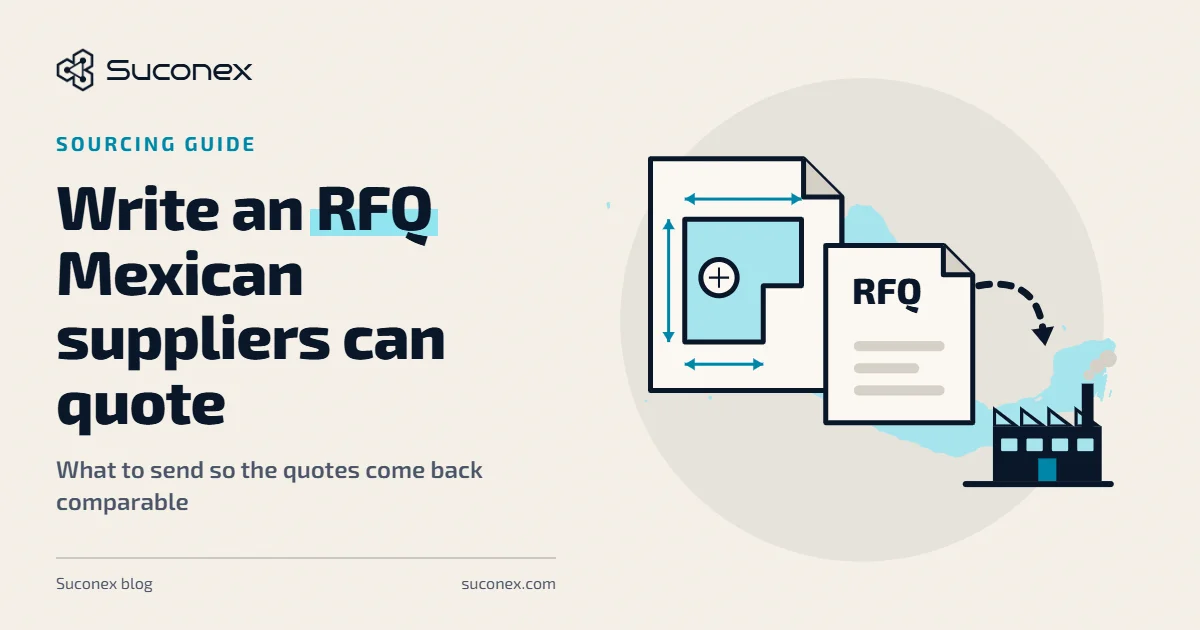
A Mexican shop gets an email with one PDF drawing and the line "please quote 5,000 pcs". It has to guess the material grade, the finish, the packaging, the annual volume and where the parts go. Some suppliers will guess, some will ask, and many will not answer at all. The quotes that do come back rest on different assumptions and cannot be compared. A good request for quotation (RFQ) removes the guessing. This guide lists what to send and what to ask for in return.
TL;DR
- Send a complete drawing package: 2D drawing with the revision, a 3D model if you have one, and the material and finish specifications.
- Give real volumes: annual usage, order size and any prototype or sample quantity. A quote for 500 pieces and a quote for 50,000 are different jobs.
- State the quality requirements up front: certifications, inspection, and whether you need a first article inspection or a PPAP.
- Fix the Incoterms rule and the named place, so that every supplier prices the same delivery.
- Ask for a fixed quote format: unit price per quantity, tooling separate, MOQ, lead times, currency and validity.
The RFQ checklist at a glance
| Section | What to include | Why it matters |
|---|---|---|
| Part | Part number, description, drawing revision, 2D drawing (PDF), 3D model (for example STEP) | The supplier quotes the right revision and can program machines from the model |
| Material and finish | Grade and specification, acceptable equivalents, coating or plating, color | Material is often the biggest cost line; "steel" is not a specification |
| Critical features | The dimensions and tolerances that matter for function | Shows where the cost and risk are |
| Volumes | Annual volume, order quantity, prototype quantity, how long the program runs | Sets the process, the tooling and the price |
| Quality | Certifications, inspection plan, FAI or PPAP level, documentation with each lot | Avoids a price that excludes required inspection |
| Packaging and labelling | Pack type, quantity per pack, labels, pallet | Prevents damage at the border transfer and surprise costs |
| Delivery | Incoterms rule, named place, delivery schedule | Makes the quotes comparable |
| Commercial | Currency, payment terms you accept, tooling ownership, quote due date | Avoids disputes later |
| Trade | Ask whether the part can qualify for USMCA and who will certify origin | Affects US duties |
1. The drawing package
Send a fully dimensioned 2D drawing with a title block, the revision letter and the general tolerances. Add a 3D model where you have one: most CNC and stamping shops will work from it, but the drawing remains the contract document. If the drawing and the model disagree, say which one rules.
Mark the critical features. If only three dimensions matter for fit and function, say so. A supplier that sees ±0.01 mm on every feature will price the whole part as a precision part.
Protect your design. Send the package only after you have checked the supplier, and use a non-disclosure agreement if the part is sensitive. Our vetting checklist covers the checks to run first.
2. Material and finish
Write the material as a specification, for example a grade and the standard it refers to, not just "aluminum" or "stainless". Say whether an equivalent grade is acceptable, because some grades are easier to source in Mexico than others, and ask the supplier to name the grade and where it buys it. That last point also matters for USMCA origin.
Specify the finish: coating type, thickness if it matters, color and any salt-spray or adhesion requirement. Finishing is often subcontracted, so ask who does it.
3. Volumes, the number that sets the price
Give three numbers:
- Annual volume (estimated annual usage), and for how many years.
- Order quantity, the size of a typical release.
- Prototype or sample quantity, if you need parts before production.
Ask for prices at two or three quantity breaks around your real order size. This shows how the price behaves and where the supplier's MOQ sits. Do not inflate the volume to get a better price; the supplier will build its process and tooling around it.
4. Quality requirements
Say what you need before the supplier prices it:
- Certifications, such as ISO 9001, or IATF 16949 for automotive parts.
- First article inspection on the first production parts, or a full PPAP at a stated level for automotive programs.
- Inspection and documents with each lot: dimensional report, material certificate, certificate of conformity.
A quote that looks cheap often leaves out inspection that you later have to pay for.
5. Packaging, labelling and delivery
Parts from Mexico usually travel by truck and are transferred at the border. Specify the packaging (box, returnable container, pallet), the quantity per pack and the labels. Then fix the Incoterms rule and the named place, for example FCA at the supplier's plant or DAP at your plant. Without it, one supplier quotes ex works and another quotes delivered to Texas. Our guide to Incoterms for buying from Mexico explains the options.
6. Commercial terms
- Currency. Say whether you want prices in US dollars or Mexican pesos.
- Tooling. Ask for tooling as a separate line, and say who owns the tool once it is paid for, where it is kept, and whether it can be moved.
- Payment terms. State the terms you accept and ask whether tooling or the first order needs a deposit.
- Quote due date and validity. Give a date for the quote and ask how long the price is valid.
- Contact. Name one person who answers technical questions, and accept questions in Spanish if you can. A supplier that asks good questions is usually a supplier that read the drawing.
7. Ask for a fixed quote format
Send a simple table and ask every supplier to fill it in:
| Line | What the supplier fills in |
|---|---|
| Unit price | Per quantity break, in the stated currency |
| Tooling or setup | One-time cost, separate from the unit price |
| MOQ | Minimum order quantity per release |
| Lead time | For samples, for tooling, and for production after PO |
| Delivery | Price basis: the Incoterms rule and named place you asked for |
| Quality | Certifications held, inspection included, FAI or PPAP cost |
| Origin | Whether the part can qualify for USMCA, and whether the supplier will certify it |
| Validity | How long the quote is valid |
| Exceptions | Anything in the RFQ the supplier cannot meet |
The "exceptions" line matters most. It turns hidden assumptions into written ones.
8. Ask about trade and origin early
Ask whether the part can meet the USMCA rule of origin and whether the supplier, as producer, will sign a certification of origin. Since July 24, 2026, products of Mexico pay an additional 10% Section 301 duty unless they enter free of duty under USMCA (CBP CSMS # 69326983). Steel, aluminum and copper content can still bring Section 232 duties even when the part qualifies. Our guide to the USMCA certification of origin explains what to ask for.
Common mistakes
- Sending an old drawing revision, or two files that disagree.
- Asking for "best price" without volumes.
- Leaving out packaging, so the cheapest quote arrives with bulk parts in one box.
- Comparing an FCA price with a DAP price.
- Writing the RFQ in English only to a shop floor that works in Spanish, with no contact for questions.
Suppliers on Suconex
The Suconex directory lists Mexican manufacturers by process and state, for example in CNC machining. Three examples, with descriptions from each company's Suconex profile:
- Precisión Omega (Chihuahua): precision machined parts with CNC milling and turning plus finishing. The profile states ISO 9001:2015.
- Sisflex (plant 1) (Monterrey, Nuevo León): family-owned steel fabricator with laser cutting, punching, stamping, bending, MIG, TIG, robotic and spot welding, powder coating and sub-assembly.
- Ingeniería en Troqueles y Moldes de Puebla (Puebla): stamping dies and molds, die design and contract stamping.
Listing on Suconex is not an endorsement. Check any supplier before you send it your drawings.
How Suconex helps
Suconex turns your drawing and quantity into a complete RFQ in Spanish, picks the Mexican suppliers that fit the part, and asks all of them to quote in the same format. You get the quotes in one table: unit price, tooling, lead time and certifications.
Send your part and get comparable quotes →
FAQ
What should an RFQ to a Mexican supplier include?
A 2D drawing with revision, a 3D model if available, material and finish specifications, critical features, annual and order volumes, quality requirements, packaging, the Incoterms rule and named place, currency, tooling terms and a fixed quote format.
Should I send my RFQ in Spanish?
English is often understood in sales and engineering, but production staff may work in Spanish. Offering a contact who can answer questions in Spanish usually improves the response and reduces misunderstandings.
How many quantity breaks should I ask for?
Two or three, around your real order size. They show how the price changes with volume and where the supplier's minimum order quantity sits.
Should tooling be quoted separately?
Yes. Ask for tooling as a one-time cost, separate from the unit price, and agree who owns the tool, where it is kept and whether you can move it.
Do I need an NDA before sending drawings?
For sensitive designs, yes. Check the supplier first, then send the drawings under a non-disclosure agreement.
Why ask about USMCA in the RFQ?
Because origin affects your US duties. Products of Mexico pay an additional 10% Section 301 duty unless they enter free of duty under USMCA, so ask early whether the part can qualify and who will certify its origin.
Sources
- U.S. Customs and Border Protection, CSMS # 69326983 (Section 301 duty on products of Mexico, HTS 9903.05.55, from July 24, 2026), https://content.govdelivery.com/accounts/USDHSCBP/bulletins/421d887 (accessed November 1, 2026).
- U.S. International Trade Commission, Harmonized Tariff Schedule, Chapter 99, U.S. note 16 (Section 232), https://hts.usitc.gov/ (accessed October 29, 2026).
- Agreement between the United States of America, the United Mexican States, and Canada, Chapter 5 (Origin Procedures), https://ustr.gov/sites/default/files/files/agreements/FTA/USMCA/Text/05_Origin_Procedures.pdf (accessed November 1, 2026).