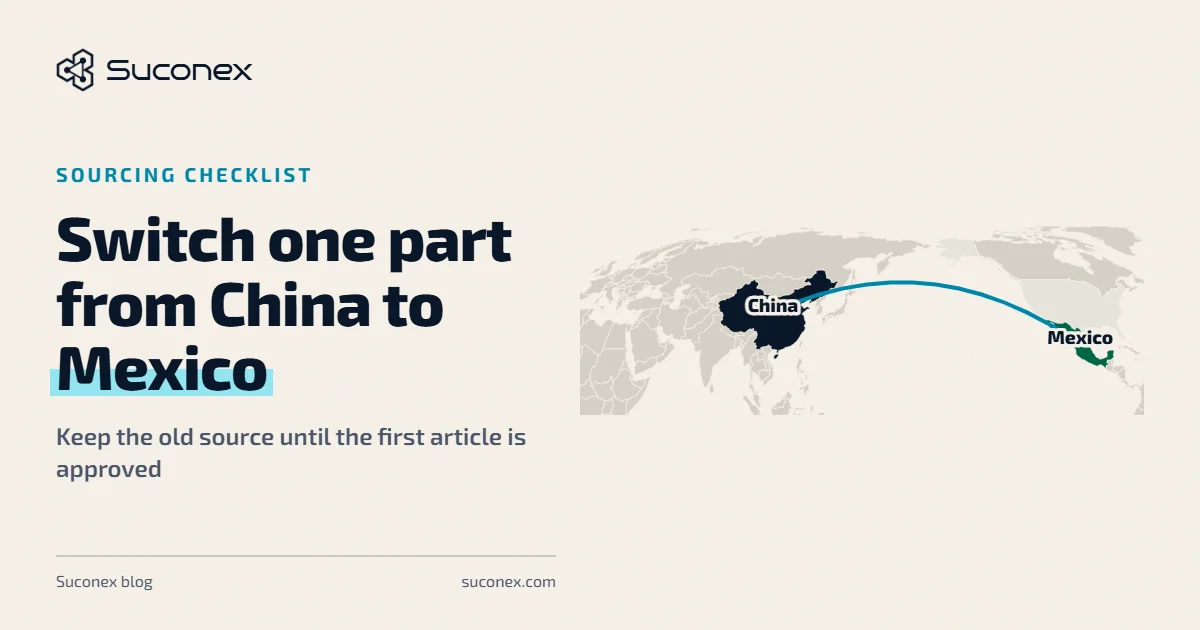
Cut over in one step and you bet a production line on a shop that hasn't made your part yet. If the first Mexican lot fails inspection, the Chinese order you canceled is gone, its replacement is weeks away by sea, and your line waits. We'd move one part at a time, and we'd keep the Chinese order open until the Mexican shop has passed a first article.
1. Start with a part you already buy
Pick one with a stable drawing. It's your benchmark.
How to check: you know today's landed cost per piece from China, not just the unit price. If not, work it out first.
2. Get the drawings and tooling rights in writing
The new shop needs the current revision, material spec and inspection criteria. Tooling is harder. If molds, dies or fixtures sit at the Chinese plant, your contract decides who owns them and whether they can leave.
How to check: you hold the latest revision and a document naming each tool's owner.
3. Translate the material spec, don't assume it
A grade written to a Chinese national standard may have no exact match at a Mexican distributor, so have the shop propose its grade and get your engineer's approval before the quote. Origin counts too. CBP requires importers to report the country where steel was melted and poured, or aluminum smelted and cast.
How to check: the quote names the grade and the mill country.
4. Send the RFQ in Spanish
Three to five shops is plenty. Put annual volume, pilot quantity, the Incoterm and an exceptions line in the RFQ, with a line like "Favor de cotizar un lote piloto de 50 piezas antes del pedido de producción." Requirements added after you choose a shop get negotiated from the weak side.
5. Check the company before any deposit
Use official lookups, not a sales call: our checklist lists them.
6. Run a pilot lot and a first article
The pilot comes off production tooling, with a full first article inspection report. China keeps shipping.
How to check: the Chinese PO stays open until you sign the first article approval.
7. Settle packing, Incoterms and origin
Pack for a truck, not a container. We'd quote FCA at the plant. Make the USMCA certification a condition of the PO. As of November 12, 2026, Mexican goods entered duty-free under USMCA skip the 10% Section 301 duty, in force since July 24, that other Mexican goods pay; Chinese goods pay 12.5% under the same action, with exemptions that include steel and aluminum products.
8. Cut over in steps
Let the first Mexican orders cover part of demand while the last Chinese order covers the rest. Close China once Mexico has shipped on time repeatedly.
Try it with one part through our free price check. We'll get Mexican quotes for it, and your Chinese supplier keeps shipping until the first article is approved.
FAQ
Should I move the tooling or build new tooling in Mexico?
New tooling costs more but lets both sources run during the pilot. Moving tools means a supply gap while they travel and get requalified.
Does the USMCA joint review change the plan?
Not yet. USTR takes comments on the 2027 joint review until January 12, 2027, and a comment period doesn't change rates. Recheck duties before cut-over.
What if the Mexican part fails the first article?
You still have China. Ask for a corrective action plan and a second first article; the RFQ should say who pays for it.
Sources
- U.S. Customs and Border Protection, "CSMS # 69326983 - GUIDANCE: Section 301 Forced Labor Import Duties" (sent July 23, 2026), https://content.govdelivery.com/accounts/USDHSCBP/bulletins/421d887 (accessed 12 Nov 2026)
- U.S. Customs and Border Protection, "CSMS # 68855869 - GUIDANCE: Further Adjusting the Tariff Regimes for Imports of Aluminum, Steel, and Copper Into the United States" (sent June 5, 2026), https://content.govdelivery.com/accounts/USDHSCBP/bulletins/41aa83d (accessed 12 Nov 2026)
- Office of the United States Trade Representative, "USTR Seeks Public Comment on the 2027 Joint Review of USMCA" (October 2026), https://ustr.gov/about/policy-offices/press-office/press-releases/2026/october/ustr-seeks-public-comment-2027-joint-review-usmca (accessed 12 Nov 2026)