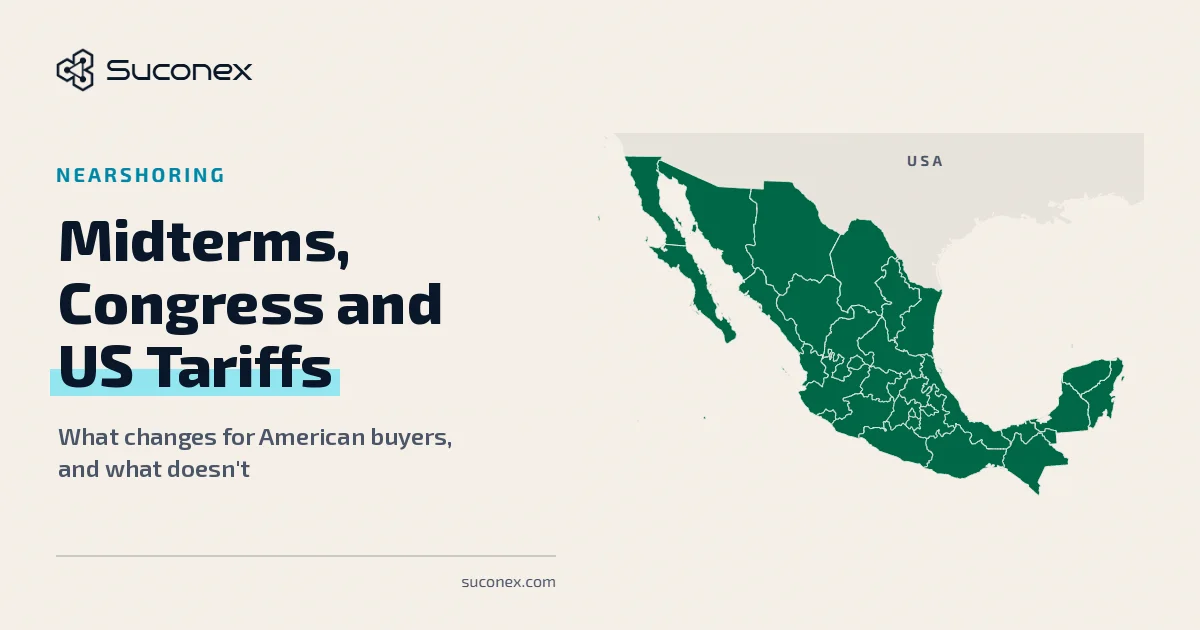
Congress flipped on Tuesday. Your tariffs didn't. Every duty still standing on steel, aluminum, auto parts and imported components rests on a law that lets the President act alone, and the new Democratic majority can't undo that over a veto. What changes is who argues about tariffs, and where that argument now happens.
The math that limits Congress
As of November 4, CBS News and NBC News project that Democrats will control both chambers when the new Congress is seated on January 3, 2027, with at least 54 Senate seats and about 255 House seats by NBC's estimate. NBC called the vote a referendum on policies that included tariffs it says drove up the prices of gas and groceries.
Now the math. President Trump's answer came fast: "I have the power of the veto." Overriding one takes two-thirds of each chamber, and neither majority has it. The tariffs themselves sit on Section 232, which covers metals, autos and parts, and Section 301, which covers the forced-labor and excess-capacity cases. Baker McKenzie calls them "the most legally durable tariff authorities," and notes that trade enforcement and China measures still have bipartisan support. Deloitte expects a targeted approach rather than repeal of all tariffs.
What it costs on the floor
Doug Rende runs an aluminum products maker in North Jackson, Ohio. He told AFP in October that tariffs and freight had added "upwards of $4.5 million to $5 million" this year, so he paused hiring and put money into robotic assembly. Not everyone loses. AFP also found American manufacturers that have gained as foreign rivals face higher barriers, and that split is what the expected new trade chairs, Richard Neal at House Ways and Means and Ron Wyden at Senate Finance, will be weighing.
Congress's one formal lever
For anyone buying from Mexico, this is where the vote counts. The law that implements the USMCA requires the administration to consult Ways and Means and Senate Finance before each joint review, and on July 1 the United States declined to renew the agreement in its current form, so the reviews continue while those committees change hands in January. We'd treat the review as the main policy risk on a Mexican quote, because it's the one lever both branches now share.
The stakes sit in the exemptions. CRS lists 232 duties of 25% to 50% on metals, 25% on autos and parts, and a 10% Section 301 duty on Mexico. Goods that qualify for USMCA duty-free treatment skip that 301 duty, and compliant auto parts skip the auto tariff. The metals exemption is narrow. In June 2026, 87% of US imports from Mexico entered under USMCA, up from 46% in January 2025.
What we'd do now
We wouldn't wait for Congress, because the duty structure it can't change is the one your suppliers are quoting against.
- Require a USMCA certificate of origin in the RFQ. It's the status that has held through every tariff swing since 2025.
- Ask for the steel and aluminum content of each part. That's where the exemption runs thin.
- Price every quote twice: at today's duties, and in a case where they change.
- Add a review clause, such as "Prices will be reviewed if US duties applicable to this part change by more than 5 percentage points."
Dates to watch: December 11, federal funding runs out. January 3, the new Congress. January 10, the scheduled end of the US-China tariff truce. January 12, USMCA comments due to USTR. Around March 2027, the statutory deadline in the 301 excess-capacity case, which names Mexico among 16 trading partners.
FAQ
Can a small US business comment on the USMCA review?
Yes. Comments go to comments.ustr.gov under docket USTR-2026-0595 by 11:59 p.m. EST on January 12, 2027, and firms under 500 employees are asked to say so.
Will the new Congress repeal the tariffs?
Deloitte doesn't expect it. It sees a targeted approach instead, and any bill would still face a veto.
Should we keep paperwork for tariff refunds?
Yes. Baker McKenzie advises companies to "preserve rights to later tariff refunds," and its post-election note treats the 301 and 232 proceedings as pending.
Last checked: 4 Nov 2026.
One part, two prices
Start with one part. Send us a drawing you're thinking of moving to Mexico, and we'll write the Spanish RFQ with the USMCA certificate and the metal-content question built in. The sample brief shows the format, and the USMCA glossary entry covers the basics.
Sources
- CBS News, "2026 Senate midterm election results as Democrats win control", updated Nov 4, 2026, https://www.cbsnews.com/live-updates/senate-election-results-2026/ (accessed 4 Nov 2026).
- NBC News, "Democrats win control of the House of Representatives with a vow to combat Trump", Nov 3-4, 2026, https://www.nbcnews.com/politics/2026-election/democrats-house-control-midterm-election-wins-trump-check-rcna603397 (accessed 4 Nov 2026).
- Reuters, "As Democrats savor big wins in Congress, Trump shows off his ballroom project", Nov 4, 2026, https://www.reuters.com/3fec1b0a85a0/legal/government/democrats-seize-congress-sweeping-midterm-repudiation-trump-2026-11-04/ (accessed 4 Nov 2026).
- Baker McKenzie, "2026 US Midterm Election Results: How Will Democratic Control of Both Chambers Impact Trade Issues", Nov 2026, https://sanctionsnews.bakermckenzie.com/2026-us-midterm-election-results-how-will-democratic-control-of-both-chambers-impact-trade-issues/ (accessed 4 Nov 2026).
- Deloitte tax@hand, "Democrats to control Congress, tax changes likely to hinge on negotiations with Trump", Nov 4, 2026, https://www.taxathand.com/article/41941/United-States/2026/Democrats-to-control-Congress-tax-changes-likely-to-hinge-on-negotiations-with-Trump (accessed 4 Nov 2026).
- AFP via France 24, "Trump's trade wars sting US manufacturers ahead of midterms", Oct 11, 2026, https://www.france24.com/en/live-news/20261011-trump-s-trade-wars-sting-us-manufacturers-ahead-of-midterms (accessed 4 Nov 2026).
- Congressional Research Service, R48859, Mexico: Background and Key Issues in U.S. Relations, Sept 23, 2026, https://www.everycrsreport.com/files/2026-09-23_R48859_4b04085ed84cb339b2ed8212b796d9dcf8d8d207.pdf (accessed 4 Nov 2026).
- USTR, "Ambassador Greer Issues Statement on the USMCA Joint Review", July 1, 2026, https://ustr.gov/about/policy-offices/press-office/press-releases/2026/july/ambassador-greer-issues-statement-usmca-joint-review (accessed 4 Nov 2026).
- Federal Register, USTR, Request for Public Comments and Notice of Public Hearing Relating to the Operation of the USMCA, Oct 5, 2026, https://www.federalregister.gov/documents/2026/10/05/2026-20341/request-for-public-comments-and-notice-of-public-hearing-relating-to-the-operation-of-the-agreement (accessed 4 Nov 2026).
- ASSEMBLY, "Midterm Results May Not Change the Biggest Trade Risk Facing Manufacturers", Nov 4, 2026, https://www.assemblymag.com/articles/100557-midterm-results-may-not-change-the-biggest-trade-risk-facing-manufacturers (accessed 4 Nov 2026).
- 19 U.S.C. 2414 (Section 301 determinations), Cornell LII, https://www.law.cornell.edu/uscode/text/19/2414 (accessed 4 Nov 2026).