A first part that looks right on a bench in Monterrey tells you almost nothing. Without a written first article inspection, you find out at your receiving dock, after the shop has run the whole lot, that one bore was never measured. The report is cheaper.
A first article inspection (FAI) is a full measurement of a part from the production process against every characteristic on the drawing, plus proof of the material and processes behind it. The best-known format is AS9102, the aerospace standard whose revision C SAE published on June 28, 2023, and its three forms work as well for a pump housing as for an aircraft bracket. Borrow them.
Here's what we'd require, in paperwork order.
1. Name the format in the RFQ
Write "AS9102C Forms 1 to 3, or an equivalent format agreed in writing". Form 1 is Part Number Accountability, Form 2 covers materials, special processes and functional testing, and Form 3, Characteristic Accountability, Verification and Compatibility Evaluation, is the measurement table you'll actually read.
How to check: ask each shop for a redacted FAI report it has done before. A shop that has never filled one in will tell you, and that's useful too.
2. A ballooned drawing
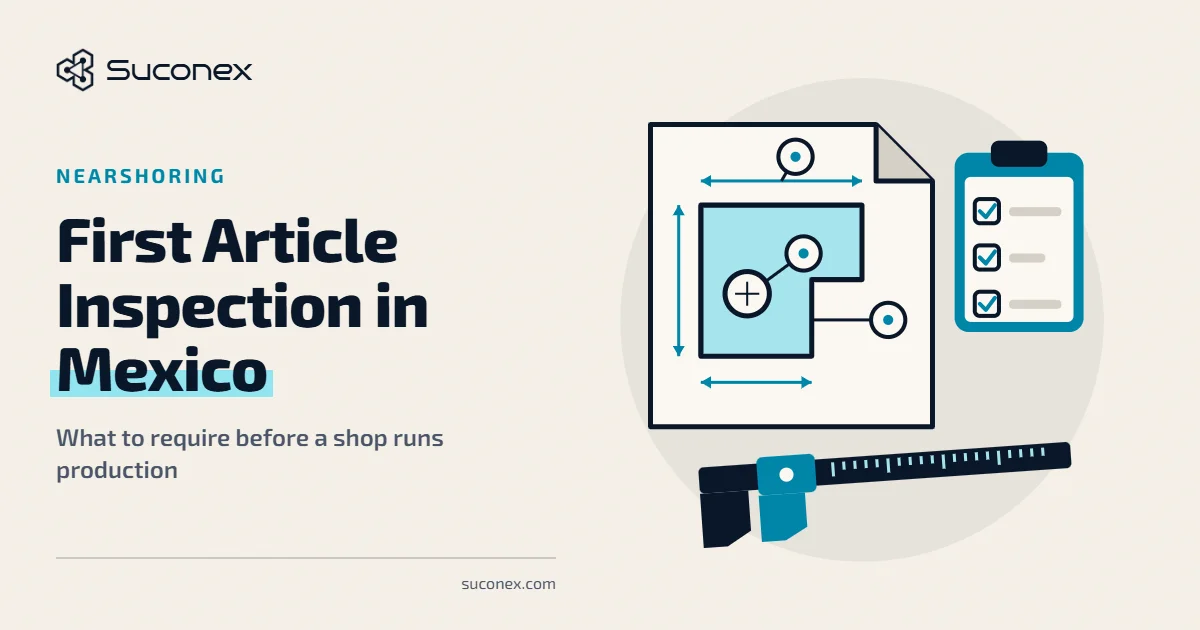
Every dimension, tolerance and note gets a number in a balloon. Form 3 gives each design characteristic a unique number. Ask for it by its shop-floor name in Spanish: plano globeado.
How to check: count the balloons. Count the rows on Form 3. They should match.
3. A number for every characteristic
A results column full of "OK" isn't a measurement. We'd reject any report that doesn't record the actual value next to each tolerance, with the gauge or instrument used.
How to check: pick three tight tolerances and read the values yourself.
4. Certificates behind Form 2
Material certificates (mill certs), heat treatment, plating, anodizing: anything you can't measure with a caliper goes on Form 2 with its certificate. The heat or lot number must match.
How to check: match the lot number on the certificate to the one on Form 2.
5. A part from production, not from the toolroom
Ask for the first article to come off the machines, fixtures and program that will run your order. A careful prototype proves the drawing can be made, not that the process will make it.
6. A written rule for when it's repeated
Form 1 asks for the reason behind every full or partial FAI, and its instructions give examples: a new part number, a lapse in production, or changes in design, process or manufacturing location. Put them in the PO. Add your own number for the lapse, say "more than 12 months without production of this part number", because a trigger nobody can measure won't trigger anything. We're not quoting the standard's own lapse rule, because its full text isn't public.
7. Inspection at the plant, or at your dock
Both work. A visit lets you watch the measuring but costs a trip for one part, while shipping the part with the report is cheaper and lets you re-measure the five or six characteristics that decide fit on your own equipment. We'd ship it. The exceptions are a large part, or tooling that would sit idle waiting for your answer.
8. A separate price line
Put the FAI in the RFQ, not the PO. Ask shops to quote it as a one-time line, apart from the unit price, so you can see who priced it and who left it out. Added after you've picked a supplier, it becomes a negotiation you start from the weak side.
The RFQ line we'd use
Before production, the supplier shall submit a First Article Inspection report on AS9102C Forms 1 to 3 (or an agreed equivalent) for one part made with the production process, with a ballooned drawing, the measured value of every characteristic, and the material and special-process certificates. Quote the FAI as a separate one-time line.
Antes de producción, el proveedor deberá entregar un reporte de inspección de primer artículo en los formatos 1 a 3 de AS9102C (o un equivalente acordado) de una pieza fabricada con el proceso de producción, con plano globeado, el valor medido de cada característica y los certificados de material y de procesos especiales. Cotizar el FAI como partida única por separado.
Our RFQ article covers the rest of the package, and the vetting checklist covers the company behind the part. For automotive parts the customer may require PPAP instead, which includes dimensional results but goes further. The short version is in our FAI glossary entry.
FAQ
Does an approved FAI mean I can skip receiving inspection?
No. The 2023 revision of AS9102 states that an FAI isn't a product acceptance document. Your receiving inspection still applies to every lot.
Do I need AS9102 if I'm not in aerospace?
No rule requires it outside aerospace. We borrow its three forms because one shared format makes reports from different shops comparable, and "an equivalent format agreed in writing" is just as good.
Last checked: 4 Nov 2026.
Getting the FAI into the first email
As of November 4, 2026, our directory lists more than 200 machining and CNC shops in Mexico. Send us the drawing and mark the characteristics you care about most. We'll write the FAI requirement into the Spanish RFQ, so each shop prices it before it quotes the part. The sample brief shows what comes back.
Sources
- SAE International, AS9102C Aerospace Series - First Article Inspection Requirements, revised June 28, 2023, https://saemobilus.sae.org/standards/as9102c-aerospace-series-first-article-inspection-requirements (accessed 4 Nov 2026).
- IAQG, 9102 Summary of Changes, Rev B to Rev C, July 11, 2023, https://iaqg.org/wp-content/uploads/2019/10/9102_Changes_07112023.pdf (accessed 4 Nov 2026).
- IAQG, 9102 Rev C forms and form instructions (draft, Appendix B), https://iaqg.org/wp-content/uploads/2023/03/Draft-9102-Rev-C-Forms.pdf (accessed 4 Nov 2026).
- Suconex supplier directory, Metal Machining & CNC, https://suconex.com/en/suppliers/metal-machining-cnc (accessed 4 Nov 2026).