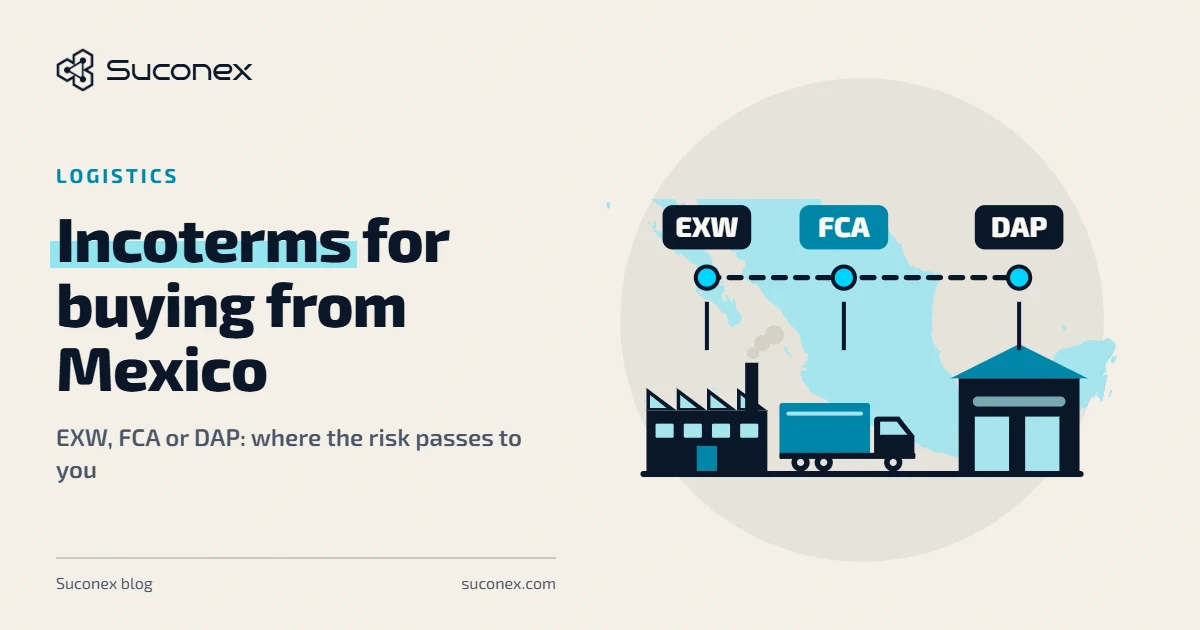
A quote from a Mexican supplier is only comparable when you know what the price includes. "USD 4.20 per piece" can mean the part sits on a pallet at the plant in Monterrey, or that it arrives at your dock in Texas. The three letters after the price, the Incoterms rule, decide who books the truck, who clears customs on each side, and where the risk of damage passes to you. This guide covers the rules that fit truck freight from Mexico and how to choose between them.
TL;DR
- Most freight from Mexico to the US moves by truck. Use the rules for any mode of transport (EXW, FCA, CPT, CIP, DAP, DPU, DDP), not the sea rules FOB, CFR, CIF or FAS.
- FCA at the supplier's plant is usually the cleanest choice if you or your forwarder book the truck: the supplier loads the truck and clears Mexican export.
- EXW puts Mexican export clearance on you, which a US buyer usually cannot do without a Mexican customs broker.
- DAP suits suppliers that already run cross-border freight: they deliver to your door, you handle US import.
- Incoterms do not decide the price, the payment terms or who owns the goods. Write those in the contract.
At a glance: the rules that fit truck freight
This guide refers to the Incoterms 2020 rules published by the International Chamber of Commerce (ICC). Always name the edition in the contract.
| Rule | Delivery (risk passes to you) | Truck to the US | Mexican export | US import and duties |
|---|---|---|---|---|
| EXW (Ex Works) | At the supplier's plant, not loaded | You | You | You |
| FCA (Free Carrier), supplier's plant | Loaded on your truck at the plant | You | Supplier | You |
| FCA, another named place | On the supplier's truck at that place, ready for unloading | Supplier to that place, then you | Supplier | You |
| CPT / CIP (Carriage Paid To / and Insurance Paid To) | Handed to the first carrier, although the supplier pays freight to the destination | Supplier | Supplier | You |
| DAP (Delivered at Place) | At your named place, ready for unloading | Supplier | Supplier | You |
| DPU (Delivered at Place Unloaded) | At your named place, unloaded | Supplier | Supplier | You |
| DDP (Delivered Duty Paid) | At your named place, import cleared | Supplier | Supplier | Supplier |
Two rules hold across the table: the seller clears export under every rule except EXW, and the buyer clears import under every rule except DDP.
Why FOB rarely fits freight from Mexico
FOB, CFR, CIF and FAS are rules for sea and inland waterway transport. Under FOB, delivery happens when the goods are on board a vessel. A truck from Saltillo to Dallas never boards a vessel, so "FOB Laredo" or "FOB our plant" leaves the delivery point and the risk transfer unclear. Many US buyers still use "FOB" in the domestic sense of the Uniform Commercial Code, which is a different system. If you mean "at the plant, loaded on my truck", the Incoterms rule is FCA.
The rules one by one
EXW (Ex Works). The supplier makes the goods available at its premises. It does not have to load them, and it does not clear them for export. That leaves the Mexican export declaration, the pedimento, with you, which means hiring a Mexican customs broker yourself. EXW looks like the lowest price, but for cross-border freight it shifts the hardest step onto the buyer. Our guide to customs brokers in Mexico explains who files what.
FCA (Free Carrier). The supplier hands the goods to the carrier you nominate, at a named place, cleared for export.
- If the named place is the supplier's plant, the supplier loads your truck.
- If it is somewhere else, for example a forwarder's warehouse near the border, the supplier brings the goods there on its own transport, and delivery happens when they are ready for unloading.
FCA gives you control of the truck and the border crossing while the supplier keeps the export paperwork, which it usually already handles.
CPT and CIP. The supplier pays the freight to the destination, but the risk passes to you when the goods are handed to the first carrier. If the truck is damaged on the way, the loss is yours even though the supplier paid for the trip. CIP adds insurance by the seller. Use them only if both sides understand that split.
DAP (Delivered at Place). The supplier delivers to the place you name, for example your plant in Texas, ready for unloading. The supplier arranges the truck, the Mexican export and the cross-border transfer; you clear US import and pay the duties. DAP works well with suppliers that already ship to US customers every week.
DPU (Delivered at Place Unloaded). Like DAP, but the supplier also unloads at the destination. It replaced the old DAT rule in 2020.
DDP (Delivered Duty Paid). The supplier delivers cleared for US import and pays the duties. This means the supplier, or someone it appoints, acts as the importer on the US entry. Few Mexican manufacturers do this, and you lose sight of how the goods were declared, including whether USMCA preference was claimed. Agree it only with suppliers that already import into the US.
How to choose
- You have a forwarder or a carrier you trust: FCA at the supplier's plant. You compare suppliers on the same basis and keep control of the crossing.
- The supplier already ships to US customers by truck: DAP to your plant. Ask which crossing and which broker they use.
- The supplier has never exported: avoid EXW. Ask for FCA, so that its Mexican customs broker files the export. If it has no broker, that tells you something about its export readiness.
- You compare quotes: ask every supplier to quote the same rule and the same named place. A DAP price and an FCA price are not comparable until you add freight and the crossing to the FCA quote. Our landed cost entry lists the cost lines.
Write the rule correctly
An Incoterms rule only works with a precise named place and the edition. Examples:
- "FCA [supplier's street address], Saltillo, Coahuila, Mexico, Incoterms 2020"
- "DAP [your plant's street address], San Antonio, Texas, USA, Incoterms 2020"
Then add in the contract what Incoterms leave open: the price and currency, the payment terms, when ownership passes, the packaging and labelling, and who provides the USMCA certification of origin.
Incoterms and US customs value
US customs value is based on the price you pay for the goods, without the costs of transport, insurance and related services for the international shipment from the country of exportation to the place of importation in the US (19 U.S.C. 1401a(b)(4)(A)). Under DAP or DDP, those costs sit inside your price. Ask the supplier to show the freight separately on the invoice, and let your customs broker decide how to declare it.
Road freight inside Mexico also needs the electronic waybill, the Carta Porte. Agree who issues it; normally it is the carrier that moves the goods inside Mexico.
Questions to ask your Mexican supplier
- Which Incoterms rule do you normally quote to US customers, and to which named place?
- Who is your Mexican customs broker, and which crossing do your trucks use?
- Can you load our truck at your plant, and at what times?
- If we buy DAP, which carrier do you use, and who handles the transfer across the border?
- Will you provide a USMCA certification of origin with each shipment or as a blanket certification?
Suppliers on Suconex
The Suconex directory lists Mexican manufacturers, many of them in border states such as Baja California and Nuevo León. Three examples, with descriptions from each company's Suconex profile:
- Gebesa Tijuana (Tijuana, Baja California): designs, makes and installs commercial and office furniture, including modular systems, seating and storage; lists upholstery, welded frames and powder coating. About 10 km by road from the Otay Mesa crossing.
- Manufacturas Metálicas Titán (Monterrey, Nuevo León): custom metal parts with laser and plasma cutting, punching, stamping, bending, rolling and assembly; finishes include galvanizing, chromating and powder coating.
- Suajes del Norte (Tijuana, Baja California): flat and rotary cutting dies, flexographic printing plates and stripping jigs, plus corrugated cardboard packaging.
Listing on Suconex is not an endorsement. Ask each supplier the questions above before you compare prices.
How Suconex helps
Suconex finds Mexican suppliers that fit your part, contacts them in Spanish and asks every one of them to quote on the same Incoterms rule and named place. Send one part through the price check and you get the quotes in one table: unit price, tooling, lead time and certifications.
Get comparable quotes from Mexican suppliers →
FAQ
What is the best Incoterm for buying from Mexico?
There is no single best rule. FCA at the supplier's plant suits buyers who book their own truck, and DAP suits suppliers that already ship to the US. EXW is usually a poor fit, because the buyer must then clear Mexican export.
Can I use FOB for a truck shipment from Mexico?
FOB is an Incoterms rule for sea and inland waterway transport, with delivery on board a vessel. For trucks, FCA expresses the same idea of delivery to your carrier at a named place.
Who clears Mexican export under FCA?
The supplier. Under every Incoterms rule except EXW, the seller clears the goods for export.
Who pays US duties under DAP?
You, the buyer. Under DAP the seller delivers to your named place, and you clear US import and pay duties and fees. Only under DDP does the seller pay them.
Do Incoterms decide who owns the goods?
No. Incoterms rules cover delivery, risk, costs and customs clearance. Ownership, price and payment terms must be agreed separately in the contract.
Does the Incoterms rule affect US customs value?
It affects what your price includes. US customs value excludes the costs of international transport and insurance to the US place of importation, so under DAP or DDP ask for the freight to be shown separately on the invoice.
Sources
- International Chamber of Commerce, "Incoterms 2020," https://iccwbo.org/business-solutions/incoterms-rules/incoterms-2020/ (accessed November 1, 2026). Rule descriptions follow the ICC Incoterms 2020 publication.
- 19 U.S.C. 1401a(b)(4)(A), "Price actually paid or payable," https://www.law.cornell.edu/uscode/text/19/1401a (accessed November 1, 2026).
- U.S. Customs and Border Protection, "Importer/Exporter Tips," https://www.cbp.gov/trade/basic-import-export/importer-exporter-tips (accessed October 29, 2026).
- U.S. Customs and Border Protection, "U.S.-Mexico-Canada Agreement (USMCA)," https://www.cbp.gov/trade/priority-issues/trade-agreements/USMCA (accessed November 1, 2026).