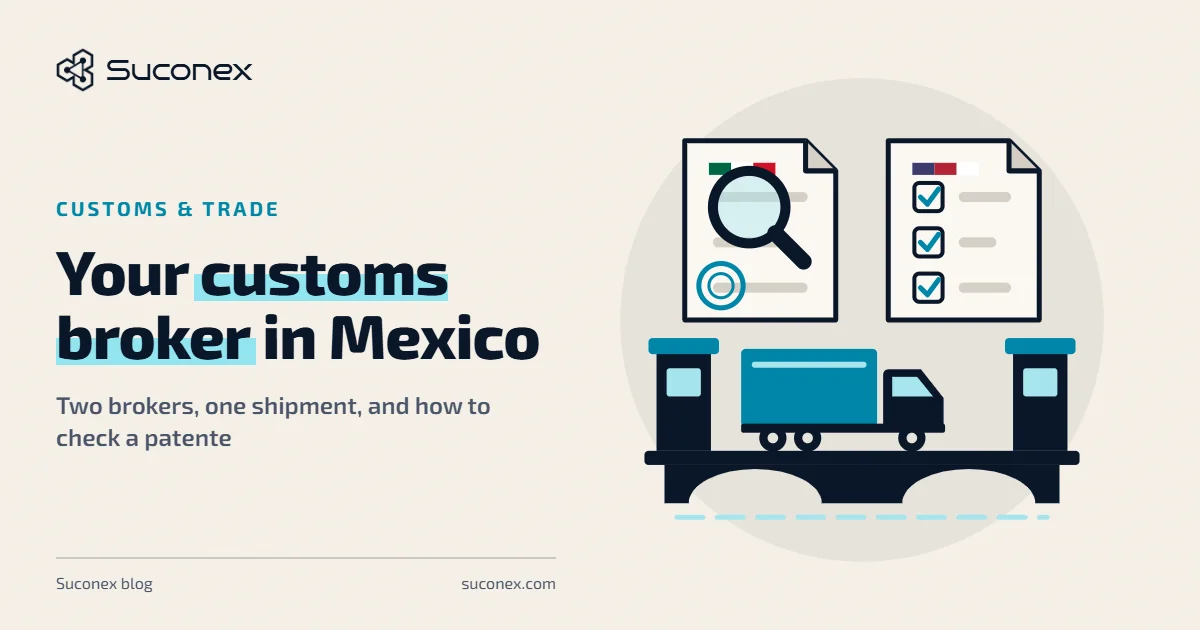
Every truck of parts from Mexico clears customs twice: first out of Mexico, then into the United States. Each side has its own licensed professional. In Mexico it is the agente aduanal, who files the export declaration (the pedimento). In the US it is a customs broker licensed by CBP, who files your entry. This guide explains what each one does, how to check that a Mexican broker really holds a patente, and what to ask before your first shipment.
TL;DR
- A cross-border shipment usually involves two brokers: a Mexican agente aduanal for the export and a US customs broker for the import.
- A Mexican agente aduanal is a person authorized by the Ministry of Finance through a patente. The 4-digit patente number appears in every pedimento number, so you can check it on the paperwork.
- In the US, brokers are licensed by CBP. Even when you use a broker, you, the importer of record, remain responsible for the entry and the duties.
- Ask both brokers for an itemised quote. The CBP merchandise processing fee is the one cost set by law; it does not apply to USMCA-originating goods.
At a glance
| Mexico (export side) | United States (import side) | |
|---|---|---|
| Who | Agente aduanal (customs broker) or agencia aduanal | Licensed customs broker |
| Authorized by | Ministry of Finance (SHCP), through a patente | U.S. Customs and Border Protection (CBP) |
| Legal basis | Ley Aduanera, articles 159 and following | 19 U.S.C. 1641 and 19 CFR Part 111 |
| Main document | Pedimento (export declaration) | Entry and entry summary |
| Who usually appoints | The exporter (your supplier), unless you buy EXW | You, the importer of record |
Two brokers, one shipment
Under most Incoterms rules (FCA, DAP and others), the seller clears the goods for export. In practice, your Mexican supplier appoints its agente aduanal, who files the pedimento and checks the export paperwork. Under EXW, export clearance is the buyer's job, so you would have to arrange a Mexican broker yourself.
On the US side, you are the importer of record unless your contract says otherwise. You either file the entry yourself or, as most companies do, hire a US-licensed customs broker. Many brokers at the big crossings, such as Laredo, Pharr and Otay Mesa, work with a partner on the other side, or have offices in both countries. This makes it easier to coordinate, but each side still needs its own license.
Road freight also needs a Mexican electronic waybill, the Carta Porte, and usually a short transfer across the bridge. Our cross-border trucking entry explains how the transfer works.
What a Mexican agente aduanal is
Under article 159 of the Ley Aduanera (Customs Law), as reformed in the Diario Oficial on November 19, 2025:
- The agente aduanal is a natural person whom the Ministry of Finance authorizes, through a patente, to clear goods through customs on behalf of others.
- The patente is personal and cannot be transferred. It is valid for 20 years and can be extended once for another 20 years.
- The agent must certify every three years to keep the patente active.
- A Customs Council (Consejo Aduanero) decides on granting, suspending and cancelling patentes.
SAT's guidance lists what the agent must check before filing: import or export permits, certificates of origin, Mexican standards (NOMs) and country-of-origin marking, where they apply. Mexico's customs agency, ANAM, also authorizes agencias aduanales, which are companies through which agents work. ANAM's website lists them.
Large manufacturers sometimes clear their own goods through an apoderado aduanal, a company employee authorized for that role. For a typical supplier, the agente aduanal is the norm.
How to check a patente
- Ask for the agent's full name and patente number. A real agent gives both without hesitation.
- Look at the pedimento number. Under Annex 22 of Mexico's General Foreign Trade Rules, a pedimento number has 15 digits. They are 2 digits for the year, 2 for the customs office, 4 for the patente (or the ANAM authorization number), 1 for the last digit of the current year, and a 6-digit sequence. If the patente in the number does not match the agent you were told about, ask why.
- Check ANAM's list. ANAM publishes the authorized agencias aduanales and the procedures for agents and apoderados. Search for the agency your supplier names.
- Ask for proof that the patente is current. Since agents must certify every three years, ask for evidence of the latest certification.
- Ask your US broker. A US broker who works at your crossing usually knows the Mexican agents there and can confirm who files for your supplier.
What your US customs broker does
CBP licenses US customs brokers under 19 U.S.C. 1641 and 19 CFR Part 111. They are not CBP employees. CBP's own words for importers: "even when using a broker, you, the importer of record, are ultimately responsible for the correctness of the entry documentation presented to CBP and all applicable duties, taxes and fees."
To set up with a US broker, expect to:
- Sign a power of attorney. Brokers must validate it under CBP's rules.
- Provide an importer number. This is usually your IRS business number (EIN); if you have none, you can request a CBP-assigned number with CBP Form 5106.
- Arrange a customs bond if your entries need one. Your broker will tell you whether a single-entry or continuous bond fits.
- Provide the HTS code, the value and the origin data. If you claim USMCA, this includes the certification of origin.
CBP lists customs brokers by port, so you can find brokers at the crossing your supplier uses.
What it costs: ask for an itemised quote
Broker fees are set by each broker and vary by crossing, volume and the number of HTS lines. We do not publish typical prices because they are not set by any official source. Ask each broker to itemise:
- The Mexican agent's fee per pedimento, and any government fees on the Mexican export.
- The bridge transfer (drayage) and any warehouse or inspection charges.
- The US broker's entry fee, any per-line charges, and the bond.
- Government fees on the US entry (see the table below).
Compare quotes on the same shipment profile, and include them in your landed cost.
Duties and fees at US entry (as of October 29, 2026)
Last checked: October 29, 2026. Sources: the official US government documents listed under Sources (CBP, Federal Register, USTR, USITC, eCFR).
| Item | Rule |
|---|---|
| Merchandise processing fee (MPF), formal entries | 0.3464% of the value, minimum $34.58, maximum $670.86 per entry, from October 1, 2026 to September 30, 2027 |
| MPF on USMCA-originating goods | Not charged (19 CFR 24.23(c)(3)) |
| 10% Section 301 duty on products of Mexico | Since July 24, 2026 (HTS 9903.05.55). Not charged on products of Mexico entered duty-free under USMCA, or on goods already under Section 232 metals or wood duties |
| Section 232 duties on steel, aluminum and copper | Up to 50%, charged even on goods that qualify for USMCA |
- USMCA certification. CBP accepts a certification of origin in any format, as long as it contains the nine minimum data elements.
- Base duty. Normal (MFN) rates depend on the HTS line. Check the US Harmonized Tariff Schedule, and see our guide to duties on Mexican parts at the US border.
Rates change often. Confirm with your customs broker before each new product ships.
Questions to ask before you hire a broker
- Which crossing do you work, and who is your partner on the other side?
- Who classifies my parts, and will you tell me when a classification is uncertain?
- How do you handle USMCA certifications, and who keeps the records?
- What do you need from me and from my supplier before the truck leaves?
- What is included in your fee, and what is charged per line, per shipment or per hour?
Suppliers on Suconex
Suconex lists manufacturers, not customs brokers. Its logistics and transportation list shows suppliers whose profiles include warehousing, distribution or road transport. Three examples, with descriptions from each company's Suconex profile:
- Exel Mexicana (Tijuana, Baja California): repairs automatic transmissions and steering systems, and offers distribution, warehousing, transport and supply chain services.
- ANA Global – Precision Metal, plant 2 (Tijuana, Baja California): precision plastic injection molding, metal stamping and assembly for medical, automotive and electronics customers; the profile also lists warehousing and distribution.
- El Maderal de San Luis (San Luis Potosí): produces and distributes sawn timber and wood products such as plywood and MDF; the profile lists warehousing and road transport.
Listing on Suconex is not an endorsement. Ask any supplier which customs broker and which crossing they normally use. The answer tells you a lot about their export experience.
How Suconex helps
Suconex finds Mexican suppliers that fit your part, contacts them in Spanish and checks their export experience, including which broker and crossing they use. Send one part through the price check and you get the quotes in one table: unit price, tooling, lead time and certifications.
Get quotes from Mexican suppliers that already export →
FAQ
Do I need a customs broker in Mexico?
Usually your supplier's Mexican customs broker handles the export, because under most Incoterms rules the seller clears export. If you buy EXW, export clearance is your job and you will need a Mexican broker.
What is a patente aduanal?
It is the authorization that the Mexican Ministry of Finance grants to a customs broker. Under the Ley Aduanera it is personal, non-transferable and valid for 20 years, with one possible 20-year extension.
How can I verify a Mexican customs broker?
Ask for the agent's name and patente number, check that the same 4-digit patente appears in the pedimento number, look up the agency on ANAM's website, and ask for proof of the latest three-year certification.
Can a US customs broker clear goods in Mexico?
No. A US license covers US customs business only. The Mexican export needs a Mexican agent or apoderado aduanal. Many brokers work with a partner across the border.
Who pays the customs broker?
Each side normally pays its own broker: the exporter pays the Mexican agent and the importer pays the US broker. Your Incoterms rule and your contract decide the details.
Is there a merchandise processing fee on goods from Mexico?
Not on goods that originate under USMCA. On other formal entries the MPF is 0.3464% of value, with a minimum of $34.58 and a maximum of $670.86 per entry, from October 1, 2026 to September 30, 2027.
Sources
- Ley Aduanera, reform published in the Diario Oficial de la Federación on November 19, 2025 (articles 159, 159 bis), https://www.diputados.gob.mx/LeyesBiblio/ref/ladua/LAdua_ref20_19nov25.pdf (accessed October 29, 2026).
- SAT, "Padrón de agentes y apoderados aduanales," https://wwwmat.sat.gob.mx/consulta/78768/padron-de-agentes-y-apoderados-aduanales (accessed October 29, 2026).
- Agencia Nacional de Aduanas de México (ANAM), "Agentes, apoderados y dictaminadores aduanales," https://www.anam.gob.mx/agentes-apoderados-y-dictaminadores-aduanales/ (accessed October 29, 2026).
- SAT, Reglas Generales de Comercio Exterior, Annex 22 (pedimento number structure), https://www.sat.gob.mx/minisitio/NormatividadRMFyRGCE/documentos2024/rgce/anexos/Anexo22_RGCE_2024_publicadas_28diciembre2023_2024_01_19_MAT_shcp.pdf (accessed October 29, 2026).
- U.S. Customs and Border Protection, "Customs Brokers," https://www.cbp.gov/trade/programs-administration/customs-brokers (accessed October 29, 2026).
- U.S. Customs and Border Protection, "Importer/Exporter Tips," https://www.cbp.gov/trade/basic-import-export/importer-exporter-tips (accessed October 29, 2026).
- U.S. Customs and Border Protection, "Find a Broker by Port," https://www.cbp.gov/contact/find-broker-by-port (accessed October 29, 2026).
- U.S. Customs and Border Protection, CBP Dec. 26-14, "Customs User Fees To Be Adjusted for Inflation in Fiscal Year 2027," Federal Register, https://www.federalregister.gov/documents/2026/07/31/2026-15530/customs-user-fees-to-be-adjusted-for-inflation-in-fiscal-year-2027 (accessed October 29, 2026).
- 19 CFR 24.23, "Fees for processing merchandise," https://www.ecfr.gov/current/title-19/chapter-I/part-24/section-24.23 (accessed October 29, 2026).
- U.S. Customs and Border Protection, "U.S.-Mexico-Canada Agreement (USMCA)," https://www.cbp.gov/trade/priority-issues/trade-agreements/USMCA (accessed October 29, 2026).
- Office of the U.S. Trade Representative, 91 FR 47318, https://www.federalregister.gov/documents/2026/07/28/2026-15181/notice-of-actions-in-section-301-investigations-of-acts-policies-and-practices-of-various-economies, and CBP CSMS # 69326983, https://content.govdelivery.com/accounts/USDHSCBP/bulletins/421d887 (accessed October 29, 2026).
- U.S. International Trade Commission, Harmonized Tariff Schedule, Chapter 99, U.S. note 16, https://hts.usitc.gov/ (accessed October 29, 2026).