
On July 1, 2026, the United States declined to renew USMCA in its current form. The agreement remains in force, but the headline was enough to send a familiar question from the CFO's office to purchasing: if we buy this part from Mexico, what do we actually pay at the border?
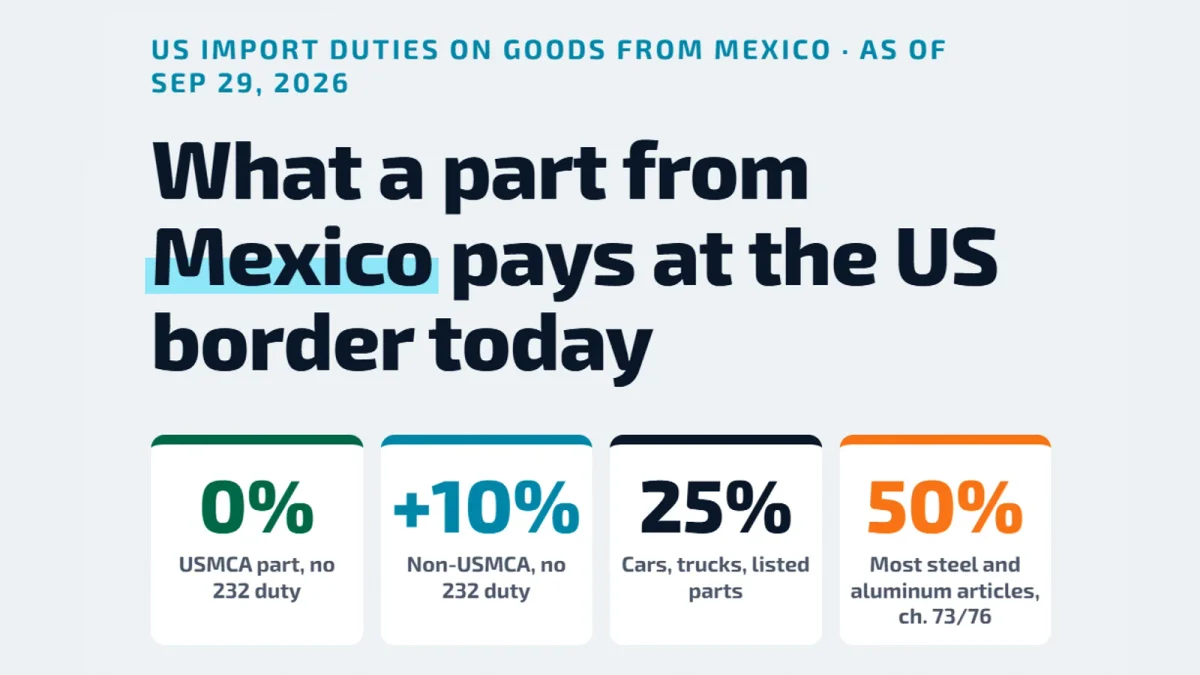
The answer depends on two facts about the part. Does it qualify for USMCA? And how much steel, aluminum or copper is in it? With those two answers you can place most industrial parts into one of four buckets. Our view: ask both questions before you compare a Mexican quote with anything else, because they can move the duty from zero to half the value of the part.
Rates below are as of September 29, 2026 (2026 HTS Revision 20, effective September 28, 2026). When we last checked, on October 21, 2026, no change to them had been announced.
The four buckets, with today's rates
Rates are additional to the normal (MFN) duty unless noted.
| Bucket | What applies | Rate |
|---|---|---|
| 1. USMCA-qualifying part, not on any Section 232 list | No normal duty, no Section 301 duty | 0% |
| 2. Part that does not qualify for USMCA, not on a Section 232 list | Normal duty plus Section 301, since July 24, 2026 | +10% |
| 3a. Most steel and aluminum articles of chapters 73 and 76 | Section 232 on the full value, USMCA or not | 50% |
| 3b. Listed parts outside chapters 72-76 with at least 15% steel, aluminum or copper by weight | Section 232 derivatives | 25% (15% total for some machinery) |
| 4a. Cars and light trucks | Section 232 autos; USMCA cars pay 25% only on non-US content, after Commerce approval | 25% |
| 4b. USMCA auto parts | No Section 232 auto duty until Commerce sets up a non-US-content process | 0% for now |
These buckets do not cover every product. Other Section 232 product tariffs exist (for example on wood products, semiconductors and pharmaceuticals) and are not covered here.
Bucket 1: USMCA part, no metals list
A qualifying part enters under the "S" or "S+" special rate, free for virtually all industrial goods, and is excluded from the 10% Section 301 duty (HTS heading 9903.05.94). The USMCA claim also removes the merchandise processing fee (19 CFR 182.11(a)).
Bucket 2: no USMCA, no metals list
The part pays the normal MFN rate for its subheading, for example 5.3% for "other articles of plastics" (3926.90.99), plus 10% under heading 9903.05.55 since July 24, 2026. USTR imposed it after finding that Mexico "failed to effectively enforce" a ban on imports made with forced labor. There is no exclusion process. Annex II, Part A of the USTR notice lists exempt products; ask your broker whether your exact line is on it.
Bucket 3: steel, aluminum and copper (Section 232)
Since April 6, 2026, Proclamation 11021 charges the metals duty "on the full customs value of the imported product, regardless of metal content." USMCA does not help here. CBP's own FAQ: "Section 232 duties may not be waived due to a Free Trade Agreement."
The tiers:
- 50%: most steel and aluminum articles of chapters 73 and 76 (such as 7318 screws and bolts or 7326 "other articles of iron or steel"), plus basic steel and aluminum and most copper articles.
- 25%: listed derivative parts outside chapters 72-76, many of them machinery parts, if the metal is at least 15% of the part's weight. Under 15%, the Section 232 rate is 0% and the importer reports the metal weight. That does not make the part duty-free. Our reading of the texts, to confirm with your broker: it is then treated like any other part, so a USMCA-qualifying one pays no extra duty, and one that does not qualify pays the normal duty plus the 10% Section 301 duty.
- 15% total, including MFN: fixed industrial machinery, power equipment, agricultural equipment and certain residential HVAC, until December 31, 2027.
- 10%: derivative articles whose metal is at least 85% by weight US-melted and poured steel, US-smelted and cast aluminum, or US copper (85% since June 8, 2026; it was 95%). Basic steel and aluminum articles do not get this tier.
The one USMCA break covers a short list of mobile industrial equipment such as forklifts, excavators and some tractors: 25% on the non-US content only, with a 15% floor, until the end of 2027. It does not apply to steel or aluminum parts in general. On October 14, 2026, Commerce defined what counts as US content here: the value of parts wholly obtained, entirely produced or substantially transformed in the US, plus, where not already counted, steel melted and poured in the US and aluminum and copper smelted and cast in the US.
A metal part that pays a Section 232 duty does not also pay the 10% Section 301 duty.
Bucket 4: vehicles and auto parts
Cars, light trucks and listed auto parts pay 25%. A USMCA vehicle pays 25% only on its non-US content, once Commerce approves the automaker's documentation.
USMCA auto parts pay no 232 auto duty for now. Proclamation 10908 holds it off until Commerce "establishes a process to apply the tariff exclusively to the value of the non-U.S. content of such automobile parts and publishes notice in the Federal Register." USTR reported on July 1, 2026 that this had not happened. If your auto part is also on a metals list, the legal texts do not settle what applies. Ask your broker.
How a part qualifies for USMCA
Article 4.2 of the agreement gives four routes. A part is originating if it is wholly obtained in the region, made only from originating materials, or made in the region from non-originating materials that satisfy the product-specific rule for its tariff heading. A fourth, narrow route uses regional value content.
For most manufactured parts, the product-specific rule in Annex 4-B decides. Usually it is a tariff shift: the imported inputs must change tariff classification in the Mexican plant. Some rules add or offer a regional value content percentage instead. There is a small tolerance, too: non-originating materials that fail the tariff shift can make up to 10% of the value, with exceptions (Article 4.12).
So a part made from imported inputs can still qualify. It depends on what happens to those inputs in the Mexican plant, and on whether someone can prove it.
The certification of origin
The exporter, the producer or the importer can complete it; the importer only with documents showing the part is originating. There is no official form. It can sit on an invoice, in English, French or Spanish, with an electronic signature. It must contain nine minimum data elements:
- whether the certifier is the importer, exporter or producer
- certifier name, title, address, phone and email
- exporter details
- producer details
- importer details, if known
- description and HS classification (six digits, or more where the rule needs it)
- origin criterion (Article 4.2 (a) to (d))
- blanket period, if it covers several shipments
- signature, date and the certification statement
A blanket certification can cover identical goods for up to 12 months. At entry, the importer claims USMCA by putting "S" or "S+" before the HTS number and must already hold the certification. The importer keeps the records for at least five years from importation; a producer that certifies keeps its cost, material and production records for five years.
Nothing obliges a Mexican producer to give you a certification (Article 5.3.4). Write it into the supply agreement.
Two safety valves: if the certification turns out to rest on wrong information, correct it promptly and pay the duty, with no penalty. If you forgot to claim USMCA at entry, you can claim a refund up to one year after importation.
What CBP verification looks like
CBP can send a questionnaire to the importer, exporter or producer, or visit the exporter's or producer's plant to observe production. It can deny the claim if the part does not qualify, the information is insufficient, nobody answers, the supplier refuses the visit, or records were not kept. A denied part drops into bucket 2, with possible penalties on top.
The certificate is a page. What holds up in a verification is the bill of materials, the cost records and the input origins behind it.
Three worked examples
Illustrative only. A real part may be classified under a different heading, and origin depends on its actual bill of materials. Assumed customs value: $10,000 per shipment. Freight and the merchandise processing fee are excluded, so the non-USMCA rows slightly understate the cost.
Example A: machined steel bracket, HTS 7326.90.8688, made in Monterrey from steel bar
| Case | MFN | Section 301 | Section 232 | Total additional duty |
|---|---|---|---|---|
| Qualifies for USMCA, steel melted abroad | 0% | excluded | 50% | 50% = $5,000 |
| Does not qualify, steel melted abroad | 2.9% | not applied | 50% | 52.9% = $5,290 |
| Qualifies, at least 85% of the steel by weight melted and poured in the US | 0% | excluded | 10% | 10% = $1,000 |
The USMCA paperwork saves 2.9%. The mill that poured the steel decides between 50% and 10%. If the same bracket were classified as a base-metal mounting under 8302.49.60, the 232 rate would be 25%, provided steel is at least 15% of its weight.
Example B: injection-molded plastic housing, HTS 3926.90.99, no metal inserts
| Case | MFN | Section 301 | Section 232 | Total additional duty |
|---|---|---|---|---|
| Qualifies for USMCA | 0% | excluded | not listed | 0% |
| Does not qualify (for example, no valid certification) | 5.3% | +10% | not listed | 15.3% = $1,530 |
Assumption: no Annex II exemption from the Section 301 duty applies to this housing. Confirm with your broker. This is the example where the certification of origin earns its keep: $1,530 per $10,000 shipment.
Example C: aluminum die-cast part, HTS 7616.99.5160
| Case | MFN | Section 301 | Section 232 | Total additional duty |
|---|---|---|---|---|
| Qualifies for USMCA | 0% | excluded | 50% | 50% = $5,000 |
| Does not qualify | 2.5% | not applied | 50% | 52.5% = $5,250 |
We did not model a US-aluminum scenario: the 10% tier is written for "derivative articles," and whether it reaches a casting classified here is a broker question. Many die-cast parts are instead classified as parts of the machine or vehicle they go into (chapters 84, 85 or 87), which moves them to a different 232 list or to the autos regime.
The pattern across the three: the same Mexican supplier can land parts at 0%, about 15% or 50%. For plastic and other non-metal parts, the paperwork decides. For steel and aluminum, it removes only the small MFN duty.
What is gone
Old headlines still circulate. Two of them no longer describe the border.
The 25% IEEPA tariff
The Supreme Court decided on February 20, 2026 (Learning Resources, Inc. v. Trump) that IEEPA does not authorize the President to impose tariffs. Collection stopped on February 24, 2026. USMCA goods of Mexico had been exempt since March 7, 2025.
Refunds run through CBP's CAPE system. Phase 1, launched April 20, 2026, covered only unliquidated entries and entries within 80 days of liquidation. Phase 3 launched on October 6, 2026; ask your broker which of your entries can be filed now. Only the importer of record or the customs broker who filed the entries can file. CBP charges no fees and warns about scams.
The 10% Section 122 surcharge
It applied from February 24 to July 23, 2026, with USMCA goods exempt. The next day, the 10% Section 301 duty took its place. So for a non-USMCA part the extra duty went from 25% to 10%, then to 10% under a different law.
What to watch
- US-Mexico talks: the 4th negotiating round was postponed, per Reuters. On October 15, the Wall Street Journal reported that a deal to cut the 50% metals and 25% car tariffs had stalled; officials of both countries denied it. Plan on today's rates.
- USMCA auto parts: once Commerce publishes a non-US-content process, the 232 auto duty starts on the non-US content of USMCA parts.
- December 31, 2027: the temporary 15% machinery tier ends, and so does the mobile-equipment rate with its USMCA clause.
- USMCA itself: not renewed on July 1, 2026, so it now gets a joint review every year. The term runs to 2036 unless extended.
Five questions to ask your Mexican supplier
- "Which 10-digit HTS code do you use for this part, and why?" The USMCA rule of origin, the Section 232 lists and the Section 301 exclusions all depend on it.
- "Does this part meet the USMCA rule of origin, and will you sign a certification of origin?" A producer cannot be forced to provide one, so put the blanket certification (up to 12 months, nine data elements) in the supply agreement.
- "What metal is in the part, what share of its weight, and where was it melted?" Steel, aluminum or copper can put the part under Section 232 even with USMCA, and the melt country decides whether the 10% tier is possible.
- "Can you back the origin claim if CBP asks?" That means bill of materials, origin of each input, supplier certifications and cost records kept five years, plus answering a questionnaire or hosting a verification visit.
- "Who is the importer of record, and who pays the duty?" Only the importer of record or its broker can claim USMCA, correct a claim or file refunds, so agree on it before the first shipment.
Where Suconex fits
Suconex helps US companies find and vet suppliers in Mexico and sources offers through an RFQ. Our advice for any Mexican part: put origin and metal content in your RFQ from the start. A supplier who answers the five questions above with documents gives you a quote you can turn into a landed cost. One who cannot gives you a price and a guess.
Questions about a specific part or supplier? Write to radim@suconex.com.
Sources
- USITC, Harmonized Tariff Schedule, 2026 HTS Revision 20 (effective September 28, 2026): https://hts.usitc.gov/reststop/releaseList
- USTR, Section 301 forced-labor final action, 91 FR 47318 (July 28, 2026): https://www.govinfo.gov/content/pkg/FR-2026-07-28/html/2026-15181.htm
- CBP CSMS # 69326983 (July 23, 2026), Section 301 duty on products of Mexico: https://content.govdelivery.com/accounts/USDHSCBP/bulletins/421d887
- Proclamation 11021, 91 FR 18201 (April 9, 2026): https://www.govinfo.gov/content/pkg/FR-2026-04-09/html/2026-06960.htm
- Proclamation 11032, 91 FR 34085 (June 4, 2026): https://www.govinfo.gov/content/pkg/FR-2026-06-04/html/2026-11314.htm
- CBP CSMS # 68855869 (June 5, 2026), Section 232 metals: https://content.govdelivery.com/accounts/USDHSCBP/bulletins/41aa83d
- CBP, Section 232 aluminum and steel FAQ (last modified September 21, 2026): https://www.cbp.gov/trade/programs-administration/entry-summary/232-tariffs-aluminum-and-steel-faqs
- Proclamation 10908 (autos and auto parts), 90 FR 14705 (April 3, 2025): https://www.govinfo.gov/content/pkg/FR-2025-04-03/html/2025-05930.htm
- USTR, 2026 USMCA Autos Report to Congress (July 1, 2026): https://ustr.gov/sites/default/files/files/agreements/FTA/USMCA/2026%20USMCA%20Autos%20Report%20to%20Congress_070126.pdf
- USMCA Chapter 4, Rules of Origin: https://ustr.gov/sites/default/files/files/agreements/FTA/USMCA/Text/04%20Rules%20of%20Origin.pdf
- USMCA Chapter 5, Origin Procedures: https://ustr.gov/sites/default/files/files/agreements/FTA/USMCA/Text/05_Origin_Procedures.pdf
- 19 CFR Part 182 (USMCA implementation): https://www.ecfr.gov/current/title-19/chapter-I/part-182
- Supreme Court, Learning Resources, Inc. v. Trump, No. 24-1287 (February 20, 2026): https://www.supremecourt.gov/opinions/25pdf/24-1287_4gcj.pdf
- CBP CSMS # 67834313 (February 22, 2026), end of IEEPA duties: https://content.govdelivery.com/accounts/USDHSCBP/bulletins/40b11c9
- CBP, IEEPA duty refunds (CAPE), last modified September 2, 2026: https://www.cbp.gov/trade/programs-administration/trade-remedies/ieepa-duty-refunds
- CBP CSMS # 67844987 (February 23, 2026), Section 122 surcharge: https://content.govdelivery.com/accounts/USDHSCBP/bulletins/40b3b7b
- USTR statement on the USMCA joint review (July 1, 2026): https://ustr.gov/about/policy-offices/press-office/press-releases/2026/july/ambassador-greer-issues-statement-usmca-joint-review
- USMCA Chapter 34, Article 34.7 (review and term): https://ustr.gov/sites/default/files/files/agreements/FTA/USMCA/Text/34_Final_Provisions.pdf
- Federal Register 2026-20938, U.S. content under Proclamation 11032 (October 14, 2026): https://www.federalregister.gov/d/2026-20938
- Foley & Lardner via National Law Review, CAPE Phase 3 (October 12, 2026): https://natlawreview.com/article/tariff-ied-week-international-trade-october-12-2026
- Mexico News Daily, citing the Wall Street Journal, tariff talks stall (October 16, 2026): https://mexiconewsdaily.com/business/us-commerce-secretarys-resistance-cutting-tariffs-stalls-trade-talks-mexico/
- Reuters, US-Mexico 4th negotiating round postponed (September 23, 2026): https://www.usnews.com/news/top-news/articles/2026-09-23/mexico-says-fourth-round-of-us-trade-talks-postponed-october-possible
Not legal or customs advice. Confirm rates with your customs broker. Rates as of September 29, 2026; last checked October 21, 2026.


