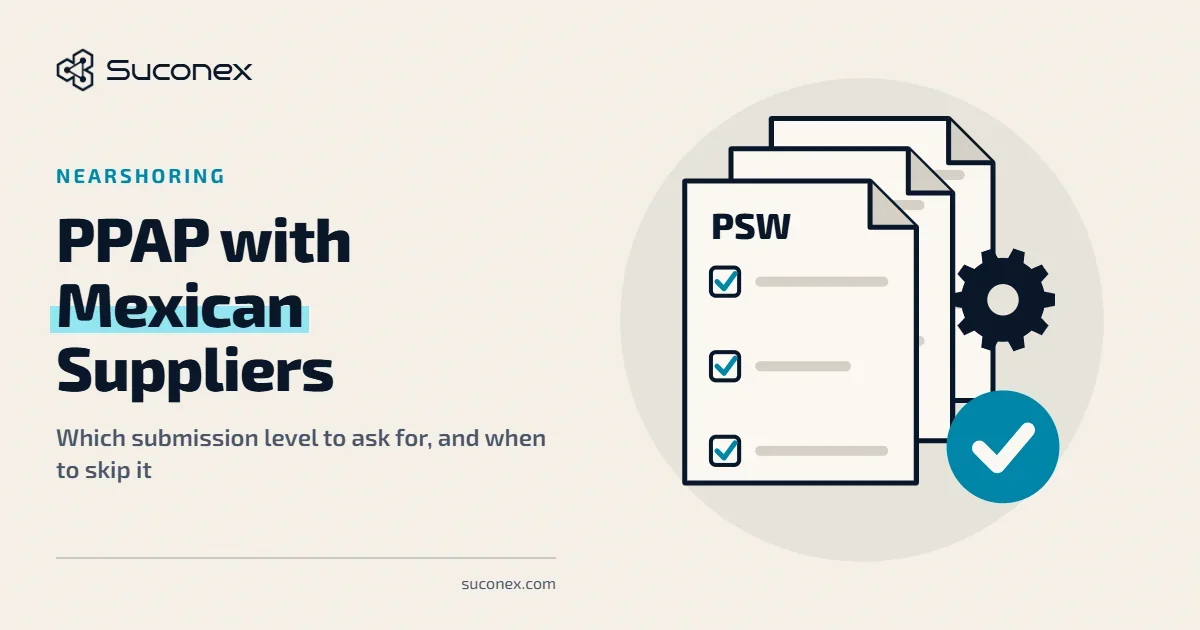
Ask for the PPAP level your own customer requires. If nobody has set one, write "PPAP Level 3" in the RFQ. And if your parts don't go into a vehicle, you probably don't need PPAP at all: a first article inspection is the better request.
The rest of this page is the reasoning.
What PPAP is, in one paragraph
PPAP is the Production Part Approval Process, published by AIAG. AIAG calls it "the industry standard for defining the production part approval process to ensure engineering design record and specification requirements are consistently met." The current manual is the 4th edition, which lists 18 requirements, numbered 2.2.1 (Design Record) to 2.2.18 (Part Submission Warrant). Between them sit the process flow diagram, the process FMEA, the control plan, measurement system studies, dimensional results, initial process studies and sample parts. More in our PPAP glossary entry.
Why the level has to be in the RFQ
The level decides how much of that evidence the plant sends you and how much it keeps on file. The manual sets this out in section 4, "Submission to Customer – Levels of Evidence", and a retention/submission table. That's a cost question, not paperwork. AIAG frames PPAP around "an actual production run at production rates", and the initial process studies and measurement system studies take that run, gauges and engineering hours, so a shop can't price a part honestly without knowing what you'll ask it to prove.
We'd write the level next to the part number, before anyone quotes. Added after you've picked the supplier, it turns into a price negotiation you start from the weak side.
Why Level 3 as the default
GM's 2016 customer-specific requirements say it plainly: "PPAP Level 3 is the default level for PPAP submission unless otherwise directed by the authorized GM representative." The same document asks for two sample parts at levels 2 and 3 unless the buyer specifies otherwise. Because a major OEM states it as the default, it's a request an automotive plant has reason to recognize.
The answer changes when your customer says something else. Ford's PPAP requirements, effective June 15, 2026, have Ford product engineering approve every process FMEA and control plan, and add approval by Ford's Supplier Technical Assistance (STA) for Level 3 and Level 5 submissions. If you're a Tier 1 passing parts into an OEM program, copy your customer's level into your RFQ, word for word.
How IATF 16949 fits in
IATF 16949 is the automotive quality system standard, and its clause 8.3.4.4 is the product approval process. GM's October 2025 requirements fill that clause with one instruction: comply with the AIAG PPAP manual and GM's supplier quality requirements. So a certificate to IATF 16949 tells you the plant runs a system that includes PPAP. It doesn't tell you it has done PPAP for a part like yours. Ask for a redacted warrant from a recent submission.
When PPAP is the wrong request
Say you buy a machined bracket for an industrial pump. You need the first parts to match the drawing and the material to be right. You don't need a process FMEA approved by a vehicle program, and some PPAP requirements, such as customer engineering approval, assume a customer who has an engineering approval process for them. We'd ask a non-automotive shop for a first article inspection plus capability data on the two or three characteristics that decide fit. That's cheaper to produce, and you'll actually read it.
The Spanish terms for your RFQ
Keep PPAP and PSW as they are; they're acronyms of the English names. For the rest, we'd write nivel 3, AMEF de proceso (process FMEA), plan de control, diagrama de flujo del proceso and estudios de capacidad. Using the plant's own vocabulary saves a round of questions.
FAQ
Is the 4th edition still current?
Yes, as of November 4, 2026. AIAG sells it as PPAP-4 (US$177 for non-members, US$60 for members), and Ford's requirements effective June 15, 2026 are written "for use with AIAG PPAP Fourth Edition".
What does the plant sign on the warrant?
The PSW declaration in the 4th edition reads: "I affirm that the samples represented by this warrant are representative of our parts, which were made by a process that meets all Production Part Approval Process Manual 4th Edition Requirements." Someone at the plant puts their name to that sentence. Ask who.
Last checked: 4 Nov 2026.
Before you collect quotes
Tell us the part and the PPAP level you need. We'll ask Mexican shops up front, in Spanish, whether they can submit at that level, so you only compare quotes from plants that said yes. Our directory lists Mexican manufacturing partners, and the RFQ article covers what else goes in the request.
Sources
- AIAG, PPAP-4 Production Part Approval Process (product page, price as of 4 Nov 2026), https://www.aiag.org/store/publications/details?ProductCode=PPAP-4 (accessed 4 Nov 2026).
- AIAG, PPAP 4th Edition Errata Sheet, 19 July 2006 (PSW declaration), https://www.aiag.org/docs/default-source/training-and-resources/errata-documents/ppap4erratasheet_july06.pdf (accessed 4 Nov 2026).
- Ford Motor Company, Customer-Specific Requirements for use with AIAG PPAP Fourth Edition, effective 15 Jun 2026, https://www.iatfglobaloversight.org/wp/wp-content/uploads/2026/06/Ford-Specifics-for-PPAP_June-2026-SCCAF-_-Final.pdf (accessed 4 Nov 2026).
- General Motors, Customer Specific Requirements for IATF 16949, October 2025 (clause 8.3.4.4), https://www.iatfglobaloversight.org/wp/wp-content/uploads/2025/10/IATF-16949-GM-Customer-Specific-Requirements-October-2025.pdf (accessed 4 Nov 2026).
- General Motors, Customer Specific Requirements (ISO/TS 16949, 2016), sections 5.2.3, 5.2.8, 5.2.9, https://www.iatfglobaloversight.org/wp/wp-content/uploads/2016/12/GM-Customer-Specifics-Requirements-ISO-TS-16949-26Oct2016-1.pdf (accessed 4 Nov 2026).
- Suconex supplier directory, https://suconex.com/en/suppliers (accessed 4 Nov 2026).